
Electromagnetic (EM) metamaterial absorbers (MMAs) represent a new generation of engineered materials capable of manipulating electromagnetic waves in ways that are fundamentally unattainable with conventional absorbers. Unlike traditional absorbing materials, whose performance is largely limited by intrinsic dielectric losses, metamaterial absorbers rely on precisely engineered subwavelength unit cells to achieve tailored resonance behavior.
Broadband MMAs are widely regarded as a critical enabling technology for next-generation wireless communications, radar stealth, electromagnetic interference (EMI) shielding, and optical camouflage. However, their development faces two persistent challenges. On one hand, resonance-based absorption mechanisms often result in narrow bandwidths, typically constrained to lower microwave frequencies. On the other hand, as MMA designs evolve toward increasingly complex three-dimensional architectures, conventional fabrication methods struggle to deliver the required structural fidelity, material compatibility, and repeatability.
Overcoming these limitations requires both innovative meta-atom design strategies and manufacturing technologies capable of translating complex micro-scale geometries into functional devices, a combination that has remained difficult to achieve until now.
A Breakthrough in W-Band Broadband Absorption
A research team led by Prof. Xiaosheng Zhang and Prof. Yi Zhang at the University of Electronic Science and Technology of China (UESTC) recently reported a major advance in this field. Their work, published in the internationally recognized journal Nano-Micro Letters under the title “Annular Microfluidic Meta-Atom Fusion-Enabled Broadband Metamaterial Absorber”, introduces a novel class of liquid-based metamaterial absorbers operating in the W-band (75–110 GHz).
At the core of this research is a fused annular microfluidic meta-atom (FAMMA) architecture. By orthogonally integrating multiple annular microfluidic resonators into a three-dimensional lattice filled with liquid, the team achieved strong, broadband electromagnetic absorption across the entire W-band—a performance level rarely reported for lightweight and compact MMA designs.
PμSL: Making Complex Metamaterials Manufacturable
The successful realization of this advanced metamaterial design was made possible by BMF Precision Technology’s Projection Micro-Stereolithography (PμSL) platform. Using the microArch® S240 system with 10 μm resolution, the researchers were able to fabricate highly intricate, hollow, and fully interconnected 3D microfluidic structures with exceptional dimensional accuracy.
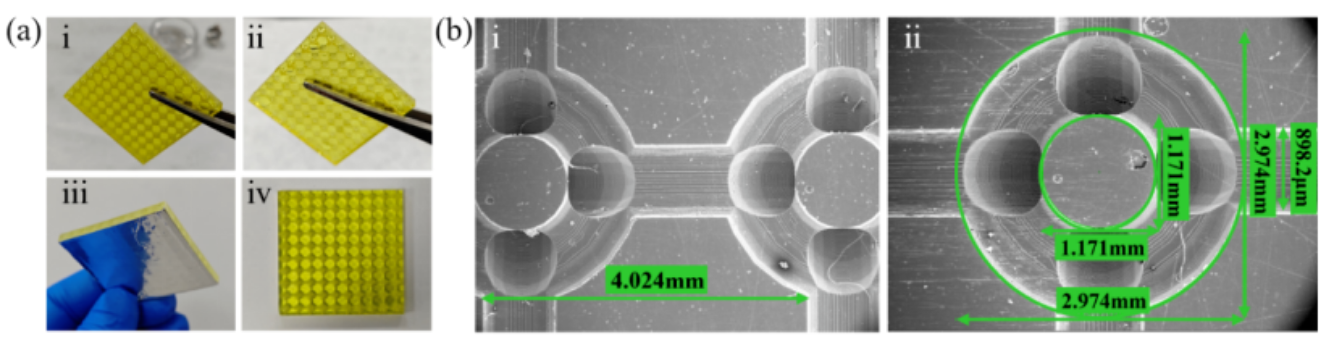
PμSL technology plays a decisive role in this work:
- True 3D micro-scale fabrication enables orthogonally fused meta-atoms that cannot be produced with planar lithography or subtractive micromachining.
- High geometric fidelity ensures that the designed electromagnetic resonances are accurately reproduced in physical devices.
- Excellent process repeatability supports scalable fabrication of complex metamaterial arrays for experimental validation and future system integration.
- Scanning electron microscopy (SEM) confirmed that the printed structures closely matched the original design, with dimensional deviations generally within 1%, a level of precision fully compatible with W-band electromagnetic testing requirements.
Experimental Validation and Radar Stealth Demonstration
After fabrication, the FAMMA devices were assembled into a 10 × 10 array with an overall size of just 4.0 mm × 4.0 mm × 3.6 mm. Water was introduced into the microchannels via vacuum-assisted filling, forming a fully functional liquid-based MMA.
Free-space measurements conducted in a microwave anechoic chamber showed excellent agreement between experimental data and simulations. Compared with previously reported water-based MMAs—which typically operate below 40 GHz and require significantly thicker structures—FAMMA delivers ultra-strong absorption in a thinner, lighter form factor, underscoring the advantage of micro-scale 3D printing–enabled design.
To further evaluate real-world applicability, the team conducted radar stealth experiments using vector network analyzers and FMCW radar imaging systems. When applied to model vehicles and aircraft, the FAMMA absorber demonstrated substantial radar echo suppression. In certain configurations, target objects became effectively invisible to radar detection, while unshielded regions remained clearly visible—direct experimental evidence of the absorber’s stealth capability.
Expanding the Frontier of Metamaterial Applications
This work highlights how PμSL micro-scale 3D printing transforms metamaterial concepts into manufacturable, testable, and application-ready devices. By enabling complex 3D microfluidic architectures with high precision, BMF’s technology bridges the gap between theoretical metamaterial design and practical deployment.
As metamaterials continue to evolve toward higher frequencies, broader bandwidths, and more compact form factors, PμSL-based micro-scale 3D printing is emerging as a critical enabling technology for next-generation electromagnetic devices.
DOI: 10.1007/s40820-025-02018-2