
In today’s fast-accelerating innovation landscape, where technology cycles are shorter and R&D timelines tighter, laboratories and engineering teams require more than precision alone. They need a versatile manufacturing platform capable of supporting diverse functional materials, complex geometries, and multi-material experimental design without compromising performance or flexibility.
To meet this demand, M150E is officially introduced: a high-precision, multi-material DLP 3D printing system with 50 μm accuracy, purpose-built for advanced research and high-end engineering development.
Designed specifically for scientific and industrial R&D environments, the M150E enables seamless switching between single-material and multi-material printin, it empowers cutting-edge experimentation and complex prototype fabrication, delivering true “one system, unlimited possibilities.”
High-Precision Single-Material Printing
In single-material mode, the M150E functions as a high-precision, research-oriented DLP 3D printing system ideally suited for material formulation optimization, curing mechanism studies, fine-feature structure fabrication, functional prototype development.
Its compact desktop footprint makes it ideal for laboratories and engineering workspaces with limited space. The system supports keyboard and mouse operation, allowing precise parameter tuning while minimizing the risk of resin contamination associated with touchscreens—an important advantage for long-term research use.
Fully Open Material Platform
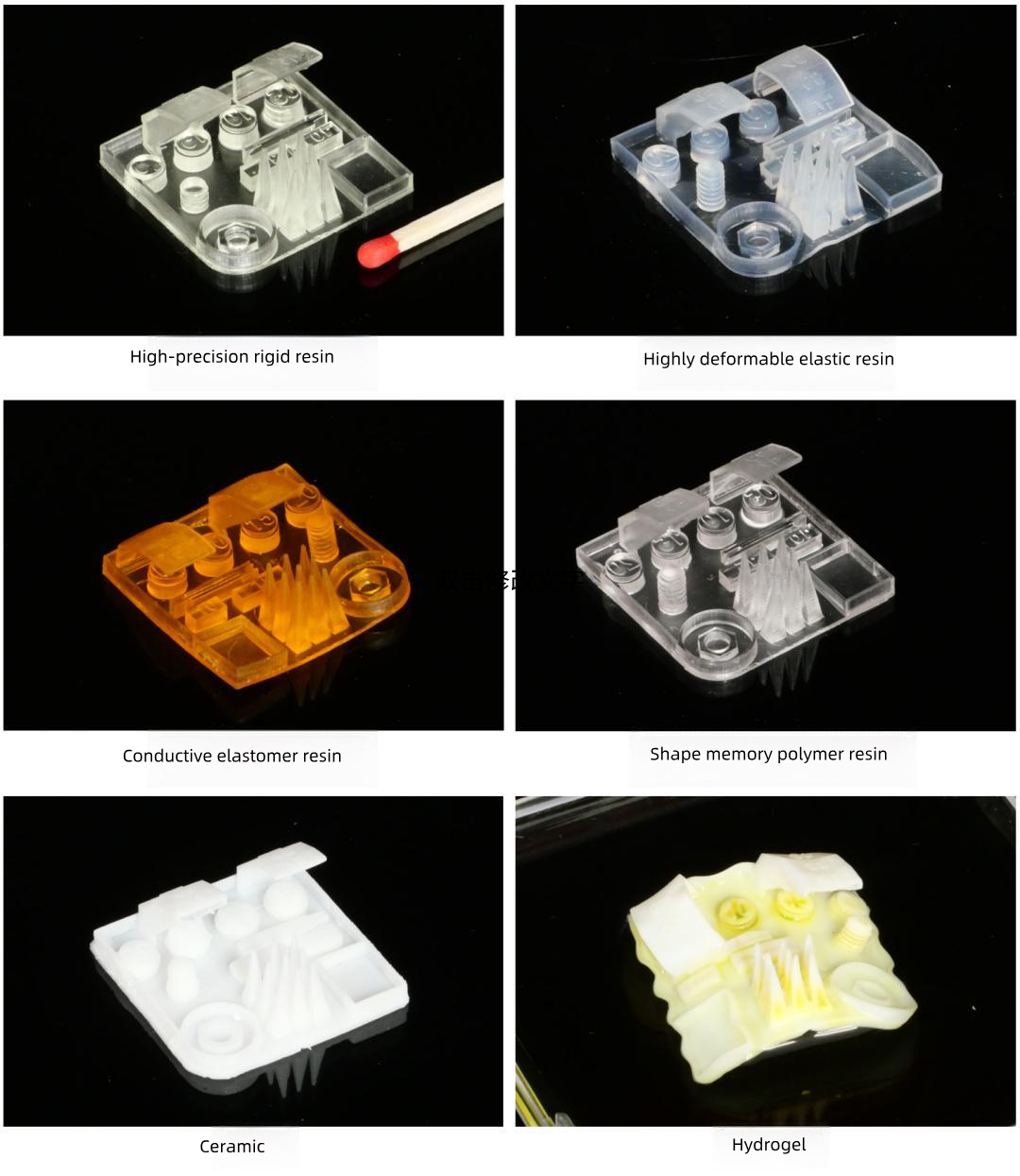
A defining strength of the M150E lies in its open material architecture. Unlike conventional high-precision systems that restrict users to proprietary materials, the M150E supports a broad range of high-performance photopolymer systems, including high-resolution rigid resins, elastomeric materials, hydrogels, conductive elastomers, shape memory polymers, ceramic slurries.
Researchers can also integrate self-developed materials with flexible parameter adjustment, eliminating the limitations of “material lock-in” and accelerating innovation cycles in material science and functional prototyping.
Multi-Material Printing: Unlocking Design Freedom
Beyond material openness, the M150E supports multi-material composite printing—enabling the integration of up to four distinct material systems within a single build.It enables the fabrication of hybrid structures composed of different materials and further supports the design of complex composites across multiple material systems.
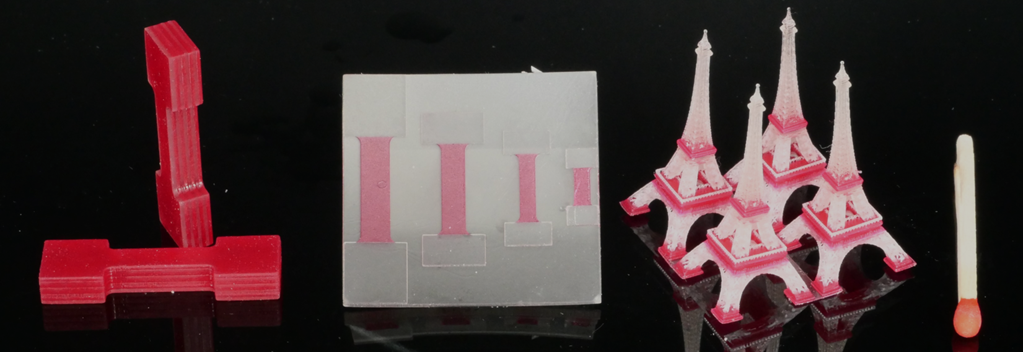
Printing with two materials
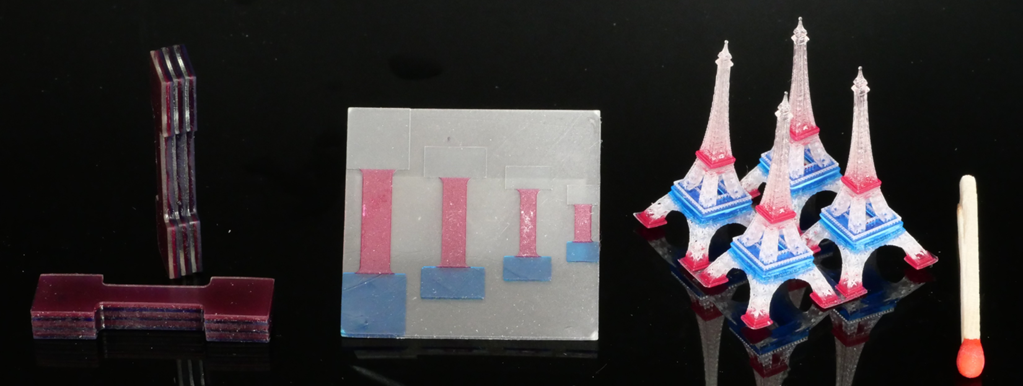
Printing with three materials
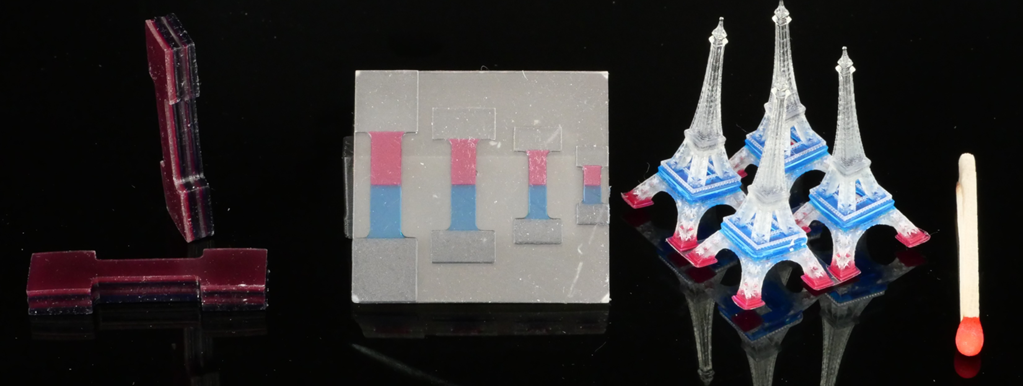
Printing with four materials
These combinations open new possibilities for functional integration and gradient material design, making the M150E a powerful platform for experimental research and advanced product development.
Application Highlights
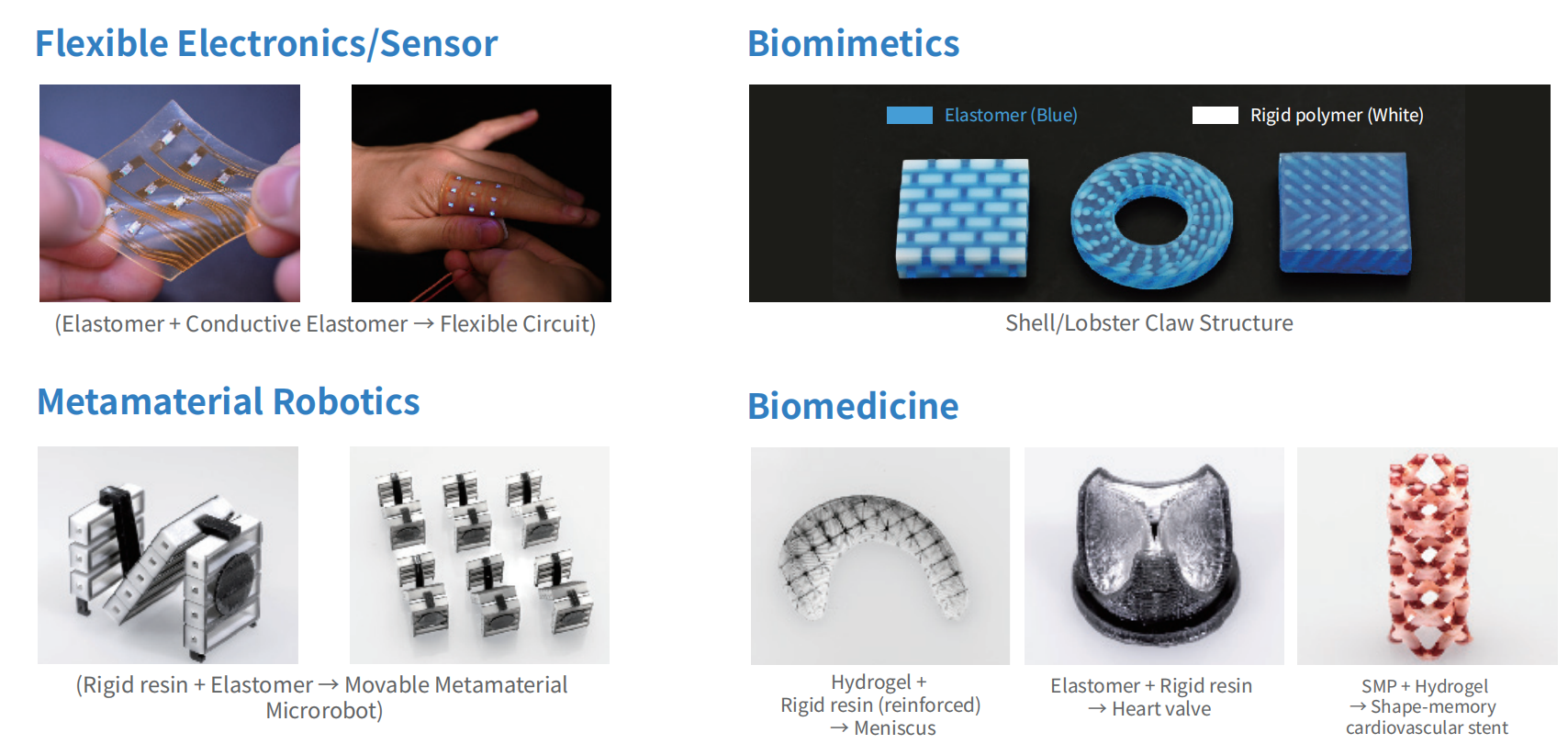
Leveraging high-precision fabrication and multi-material integration, the M150E serves a wide range of advanced applications:
Robotics
Print integrated rigid–flexible composite structures in a single build, enabling the functional integration of joints, actuators, and housings.
Flexible Electronics
Combine conductive and encapsulation materials to manufacture stretchable circuits, embedded sensors, and flexible electronic components.
Biomedical Engineering
Utilize biocompatible hydrogels and support materials to prototype cardiovascular scaffolds, drug delivery systems, and soft biomedical devices.
Metamaterials
Enable precise microstructure design using multi-material architectures to tailor mechanical, acoustic, and electromagnetic properties with high accuracy.
A Platform for Next-Generation Innovation
As high-end manufacturing, scientific research, and biomedical engineering increasingly demand heterogeneous material integration, functional gradient structures, and complex internal geometries, the M150E stands as a key enabling platform.
Through continuous system integration and material innovation, BMF aims to provide global research institutions and advanced manufacturers with more flexible, open, and highly integrated additive manufacturing solutions—driving the next generation of “design–material–manufacturing” convergence.