

At the forefront of interdisciplinary research in photonics and applied nanosciences, the Manipal Institute of Applied Physics (MIAP) at the Manipal Academy of Higher Education (MAHE), India, continuously explores advanced fabrication approaches to support cutting-edge micro-scale research.
To overcome the limitations of conventional microfluidic fabrication, MIAP adopted the BMF microArch® S140 system, enabling rapid prototyping of complex microstructures and high-precision tooling for PDMS soft lithography.This transition has significantly improved fabrication efficiency, design flexibility, and structural precision, empowering researchers to accelerate innovation in microfluidics and nano-biophotonics.
The Challenge: Limitations of Conventional Microfluidic Fabrication
Microfluidic devices are traditionally fabricated using layer-by-layer lamination techniques, which involve cutting micro-scale features into individual layers,aligning and bonding these layers into a final device. While suitable for certain applications, this approach presents several key challenges:
1.Limited design flexibility, especially for complex 3D geometries
2.Time-consuming fabrication workflows
3.Difficulty in achieving high aspect ratio microchannels
4.High costs associated with mass production methods like injection molding
For a research-driven institute like MIAP, these constraints slowed down iteration cycles and limited experimental exploration.
The Solution: BMF microArch® S140 system
To address these challenges, MIAP implemented the BMF microArch® S140 system, known for its ultra-high resolution and precision.Through its speed and precision, allows for rapid prototyping and can produce intricate parts. It allows for more design flexibility and accommodates more complicated devices. This fabrication method allows us to print 3D channels that are as small as 100 microns and that have high aspect ratios.
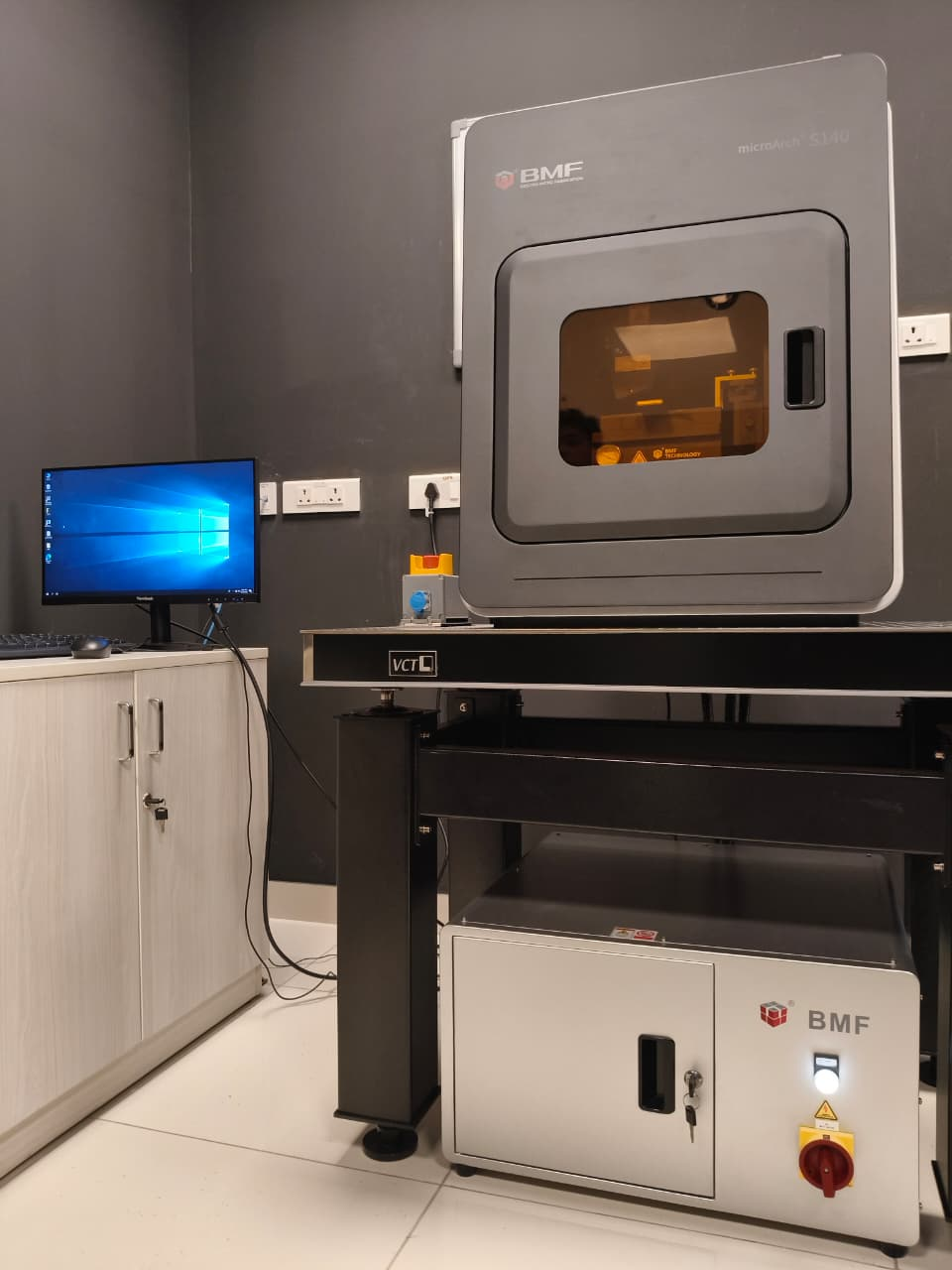
Figure 1: BMF microArch® S140 system
Key Capabilities
1.10 μm resolution enabling true micro-scale fabrication
2.Ability to produce microchannels as small as 100μm
3.High aspect ratio structures with excellent dimensional control
4.Superior surface quality for functional microfluidic performance
More importantly, the system enables direct fabrication of microstructures and high-precision molds for PDMS replication, bridging additive manufacturing with traditional soft lithography workflows.
Application: BMF’s micro 3D Printing + PDMS Soft Lithography
At MIAP, the integration of high-resolution micro 3D printing with PDMS soft lithography has established a powerful and flexible microfabrication workflow. Rather than relying solely on conventional photolithography, researchers leverage the BMF microArch® S140 to directly fabricate precision master molds, which are then used for PDMS replication.
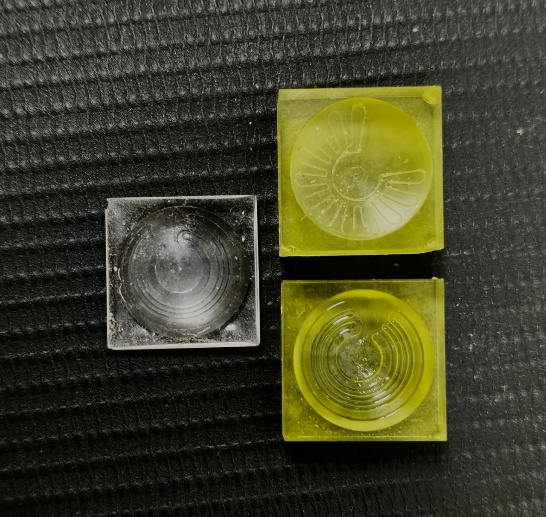
Figure 2: Using the BMF S140 printing mold, and then obtaining the target structure through the PDMS mold-making process.
The process begins with the digital design of microfluidic architectures, where complex geometries, such as curved microchannels, multi-level networks, and high aspect ratio features—can be defined without the constraints of planar fabrication.Using the S140 system, these designs are translated into physical master molds with micron-level precision. With a resolution down to 10 μm and excellent surface finish, the printed molds exhibit smooth surfaces suitable for fluidic applications.
The liquid PDMS is poured over the 3D printed mold, allowing it to fully infiltrate micro-scale features, including narrow channels and high aspect ratio structures.The assembly is cured at elevated temperatures (typically 60–80°C), solidifying the PDMS into an elastomeric replica that precisely conforms to the mold geometry.After curing, the PDMS layer is carefully peeled off, preserving fine structural details. The replicated structure can then be bonded—commonly via plasma treatment—to glass or other substrates, forming a sealed microfluidic device ready for use.
“We are now able to print complicated microstructures within a very short period without compromising resolution or design integrity.”
— Vivek M, Ph.D. Research Scholar, MIAP
User Experience: Reliable Performance and Strong Support
Beyond the technical capabilities of the S140 system, MIAP emphasizes that the value of this collaboration extends to the overall experience with Shree Rapid Technologies (SRT).
From initial evaluation to post-installation support, SRT played a critical role in ensuring a smooth and efficient adoption process. Through clear technical guidance, responsive communication, and hands-on support, the team enabled MIAP to quickly translate system capabilities into practical research outcomes.
“We appreciate the reliability of the solution, the excellent print quality, and the consistent part performance. The overall experience with SRT has been smooth, professional, and supportive.”
— Vivek M, Ph.D. Research Scholar, MIAP