
Nature has long served as an inspiration for engineering innovation. From the aerodynamics of bird wings to the adhesive ability of gecko feet, biological systems often exhibit structural designs that outperform conventional engineered solutions. Today, advances in micro-scale additive manufacturing are enabling researchers not only to replicate these natural architectures but also to translate them into functional engineered systems. Among these technologies, micro-3D printing has emerged as a powerful tool for biomimetic research, allowing scientists to fabricate complex microstructures with exceptional precision.
A recent study led by researchers from City University of Hong Kong and collaborating institutions demonstrates how high-resolution micro-3D printing can reproduce a remarkable sensing mechanism found in sea urchin spines. By combining biomimetic design with advanced materials, including BMF’s HTL resin, the team successfully created artificial structures capable of converting mechanical stimuli into electrical signals, opening new possibilities for underwater sensing and intelligent materials. This milestone research was successfully published in the top international journal Nature, with the title “Echinoderm stereom gradient structures enable mechanoelectrical perception”.
Discovering a Unique Sensing Mechanism in Sea Urchin Spines
Sea urchin spines appear simple at first glance, yet they possess an extraordinary structural design. Internally, the spine is composed of a highly porous, interconnected skeletal network that gradually changes along its length. This gradient structure plays a crucial role in the spine’s ability to interact with its surrounding environment.
Experimental observations revealed that individual spines can respond rapidly to external stimuli such as liquid droplets or fluid flow. When stimulated, a spine can produce measurable electrical signals associated with fluid movement along its porous structure. Importantly, this sensing capability does not rely on living cells within the spine but rather originates from the physical interaction between the porous mineral framework and the surrounding liquid.
Researchers found that the gradient porous architecture significantly enhances interactions at the solid–liquid interface. When liquid moves through the micro-scale pores, shear forces and charge redistribution at the interface generate an electrical potential. The result is a fast and repeatable mechanoelectrical response that enables the spine to detect changes in its environment.
This discovery suggested that structural design alone—without complex electronics or biological tissue—could enable sensing capabilities. The next challenge was determining whether such a structure could be recreated artificially.
Micro-3D Printing Enables Biomimetic Structural Replication
Replicating the intricate architecture of biological structures requires manufacturing techniques capable of controlling geometry at the micron scale. Traditional fabrication methods struggle to produce complex porous gradients with high precision. Micro-3D printing, however, offers a solution by enabling layer-by-layer fabrication of finely controlled microstructures.
In this study, the research team adopted high-resolution photopolymerization-based micro-3D printing to build artificial structures inspired by sea urchin spines. This technology allows the creation of intricate lattice and porous geometries with precise control over feature size, curvature, and spatial gradients.
Using this approach, the team fabricated biomimetic samples that replicate the gradual variation of pore structures found in natural spines. The design includes interconnected porous networks whose size and density change along the structure, enabling controlled fluid interaction similar to the natural system.
The Role of BMF HTL Resin in High-Performance Biomimetic Structures
A critical factor in reproducing functional microstructures is the material used during fabrication. The study incorporated BMF’s HTL resin, a high-performance photopolymer designed for precision micro-fabrication.
HTL resin offers several properties that make it particularly suitable for biomimetic micro-3D printing:
- High thermal stability, enabling structures to maintain dimensional accuracy and structural integrity during testing and operation
- Excellent mechanical performance, supporting delicate yet stable micro-architectures
- Compatibility with high-resolution printing processes, allowing the fabrication of complex porous geometries with micron-scale fidelity
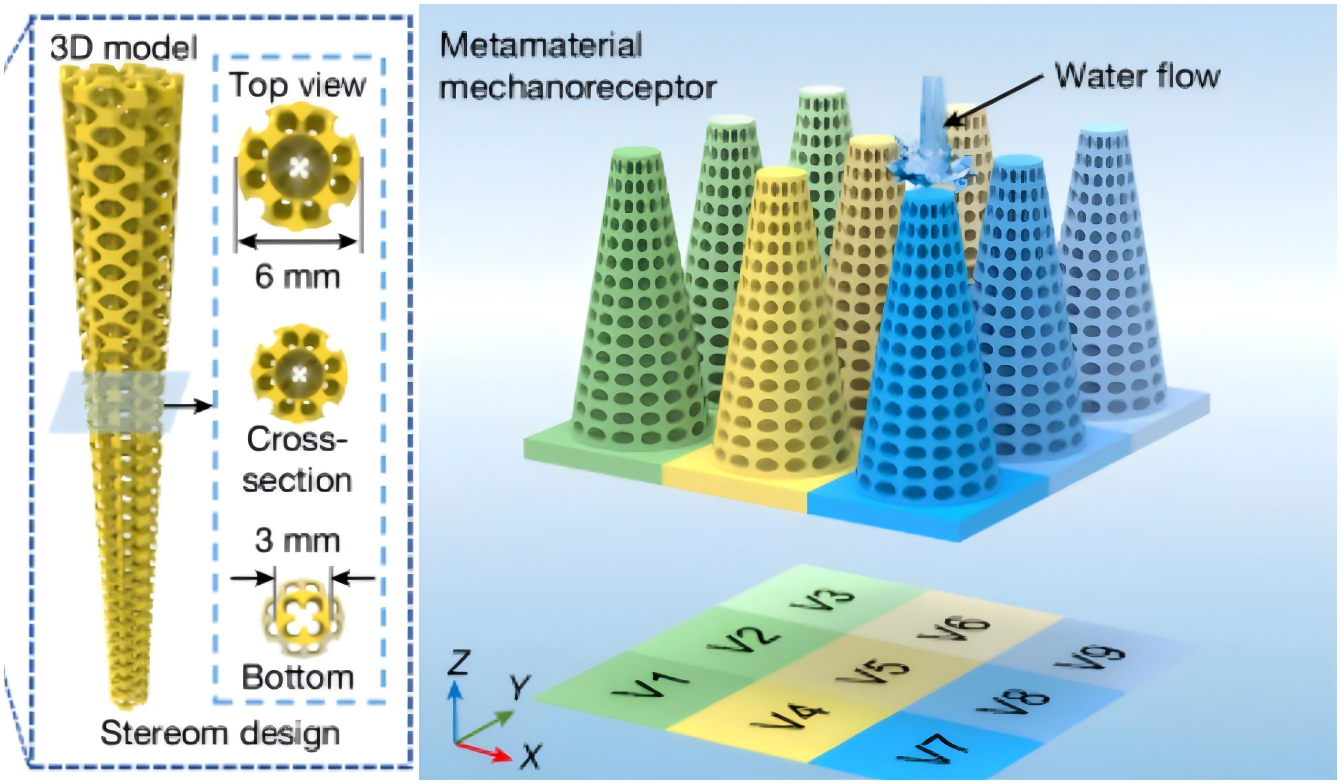
Figure:The gradient cell structure endows mechanical and electrical perception with universality, practicality and applicability.
These characteristics allow researchers to produce microstructures that closely match the designed architecture without deformation or collapse during printing.
Expanding the Frontier of Biomimetic Micro-Manufacturing
Beyond this specific example, the study illustrates a broader shift in additive manufacturing. Micro-3D printing is evolving from a tool for replicating structures to a platform for designing functional materials inspired by nature.
By combining advanced materials such as BMF’s HTL resin with high-precision micro-fabrication technologies, researchers can create new classes of biomimetic devices that integrate structural design with functional performance.
As micro-3D printing technology continues to advance, the boundary between natural inspiration and engineered functionality will become increasingly blurred, enabling a new generation of biomimetic innovations.
Explore the complete technical paper :
https://doi.org/10.1038/s41586-026-10164-9